
Maths


Subject Leads


Maths at Bidston Village


-
Our dedicated Maths Team, Mrs De-Brabander and Mr Rosser, work across the school, supporting children from Sunflowers (2-year-olds) right through to Year 6. They are passionate about helping every child develop confidence, fluency, and a love of mathematics.
They aim to make maths fun, engaging and accessible, using a wide range of resources, hands-on activities, and real-life problem-solving opportunities. Lessons are carefully planned to meet the needs of each child, providing support and challenge so that every pupil can reach their potential.
From exploring numbers and shapes in Early Years to tackling fractions, multiplication, and reasoning in Key Stage 2, Mrs De-Brabander and Mrs Kennedy work together to create a consistent and exciting maths journey for all children.
-
The intent of the maths curriculum at Bidston Village CE Primary School is to provide a high-quality education that inspires a love of maths, develops mastery of mathematical concepts, and equips pupils to apply their skills confidently in everyday life.
We follow the White Rose Maths scheme, which supports the development of fluency, reasoning, and problem-solving. New concepts are introduced using a concrete, pictorial, abstract approach, enabling all children to experience hands-on learning when exploring mathematical topics. To embed knowledge and vocabulary, retrieval practice takes place in our lessons as part of our pedagogy, helping children recall and apply what they have learned.
We aim for pupils to:
become fluent in the fundamentals of mathematics, developing conceptual understanding and the ability to recall and apply knowledge rapidly and accurately.
solve problems by applying their mathematical skills in a variety of real-life contexts.
reason mathematically by following a line of enquiry and presenting justifications, arguments, or proofs using precise mathematical language.
appreciate number and number operations, enabling mental calculations and written procedures to be performed efficiently, fluently, and accurately.
Our curriculum ensures that children not only gain the skills needed to succeed in maths but also develop confidence, curiosity, and enjoyment in the subject from nursery through to year 6.
-
The mathematics curriculum at Bidston CE Primary School is carefully planned, sequenced, and taught with clarity and enthusiasm to create a learning environment that is both challenging and supportive. Teachers use a wide range of strategies, including active and collaborative learning, and provide frequent opportunities for pupils to practice, discuss, and deepen their understanding.
Throughout the curriculum, there is a strong focus on fluency, reasoning, and problem-solving, with regular formative assessment to monitor progress and identify where additional support is needed. Mathematical key vocabulary and language are developed through the use ofsentence stemsduring learning blocks.
In EYFS, mathematics is taught daily and enhanced through play using the Early Years Foundation Stage (EYFS) Framework 2025. Evidence is collected on Evidence Me to document each child’s journey in mathematics. Children in Nursery and Reception are taught the White Rose Maths curriculum daily and the Reception children also take part in daily additional Mastering Number session, which helps to build firm foundations in number sense.
In Key Stage 1 and Key Stage 2, mathematics is taught daily using the White Rose Curriculum using the prioritisation of skills to ensure solid mathematical foundations, gaps are addressed and all areas of thenational curriculum are delivered,breaking learning into small, coherent steps and integrating fluency, reasoning, and problem-solving. Alongside daily lessons, children take part in threeadditional, 10-minute Mastering Number sessions each week to further develop their number sense.
A range of reasoning resources is used to challenge all children and give them opportunities to apply their understanding. Weekly interventions ang. re put in place using pre-teach, Numberstacksand quick, targeted daily interventions to support those who need additional help.
Lessons follow a Concrete, Pictorial, Abstract approach to guide children through mathematical processes. Where possible, links are made with other subjects across the curriculum to make learning meaningful and connected.
Children are also encouraged to practice times tables at home to consolidate their learning and support automatic recall.
-
The impact of the Maths curriculum at Bidston Village CE Primary school is good. Pupils make progress from their starting points. They have a love of learning and a strong sense of curiosity about Maths and they apply their knowledge and skills with confidence in everyday situations. The curriculum enables pupils to apply their Maths skills in the wider world and makes connections with other subjects, such as science and geography. Pupils are building resilience when confronting mathematical challenges. Teachers and leaders closely evaluate the impact of the curriculum, using assessment and pupil feedback to continually improve and adapt their teaching approaches.
-
No more counting in ones!
Bidston Village CE Primary is taking part in the National for Excellence in the Teaching of Mathematics (NCETM) project to support the teaching of basic maths skills in our school.
This project aims to secure firm foundations in the development of good number sense (a deep understanding of number) for all children from Reception through to Year 5.
The aim over time is that children will leave KS1 and begin KS2 with fluency in calculation and a confidence and flexibility with number. Research shows that children with secure ‘number sense’ early on will make more progress later on in Maths and across the curriculum.
Reception classes have a daily ‘Mastering Number’ session and in KS 1 each class has an additional lesson 3x per week in addition to their maths lesson. Over the year, the children will experience using a range of resources and representations, including a small abacus-like piece of equipment called a rekenrek.
-
Shown below is the ‘Ready to Progress’ criteria for each year group in six key mathematical areas:
Place Value
Fluency
Addition and Subtraction
Multiplication and Division
Fractions
Geometry
For pupils to be able to successfully access the curriculum in the next academic year, they should leave their current year group being able to understand and use the mathematical skills and knowledge listed. If a child is struggling to grasp an idea in maths, we use this document to track back to the underlying missing knowledge and give them the crucial learning experiences they need to plug this gap and accelerate their progress back to their year group's expectation.
-
"I like counting the blocks and making towers." – Nursery
"I enjoy using the number songs in class." – Reception
"I love pouring the water and seeing which is more." – Reception
"I enjoy Mastering Number because it helps me get quicker at my sums." – Year 1
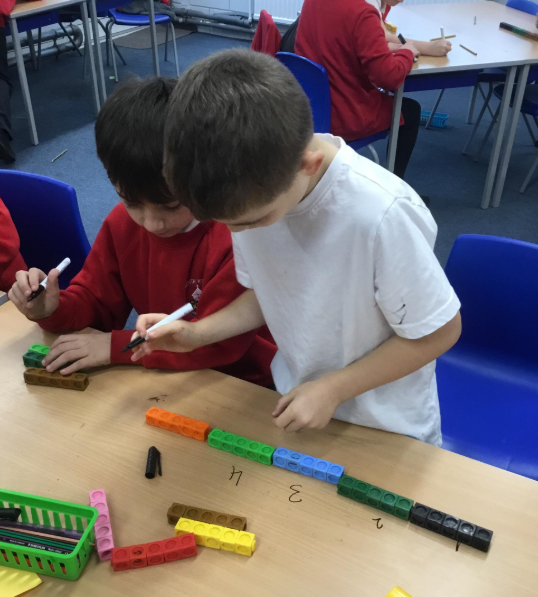
"I like using the cubes to solve addition and subtraction problems." – Year 2
"Maths is fun when we do puzzles and try to find the answer together." – Year 2
"I like learning new strategies to solve problems, it’s like a challenge." – Year 3
"Using the White Rose steps helps me understand tricky questions." – Year 3
"I feel proud when I can explain my reasoning to the class." – Year 4
"I enjoy using different resources like counters and shapes to help me work things out." – Year 4
"Problem-solving is fun because we get to think creatively." – Year 5
"Mastering Number sessions help me remember facts quickly." – Year 5
"I like reasoning questions because I can show how I know the answer." – Year 6
"I enjoy linking maths to real-life problems, like measuring and budgeting." – Year 6